Newt:多任务世界模型阅读笔记
从专家示范预训练到在线交互,记录 Newt 如何在潜在空间学习动力学、奖励与价值,并与 DINO-WM 作比较。
Newt: Reading notes on multitask world models
From demonstration pretraining to online interaction: how Newt learns latent dynamics, rewards, and values, and how it compares with DINO-WM.
下面是世界模型第二篇文章,这里同样用不涉及数学的方式记录下文章的思路和方法。
Learning Massively Multitask World Models for Continuous Control,ICLR 2026
Newt 想解决什么
这篇文章作者同样认为世界模型应该具有泛化性,发布了一个包含200个多样化的任务benchmark。
并提出了自己的模型Newt:先看大量已有的示范轨迹,让模型学会相关任务大概在干什么以及通常应该怎么动。然后让同一个Newt真正在很多任务里与环境交互,根据获得的新经验进一步迭代模型。 (感觉思想其实和dinowm很像,都是要提出一个泛化到多个任务的模型,思路也比较类似 离线预训练 + 在线优化,有意思)
对世界模型的要求
作者认为合理的世界模型方法应该满足:
- (i) 随着模型和数据规模的增加而扩展(scaling law)
- (ii) 对各种观测空间、动作空间、奖励函数和任务时长具有鲁棒性(模型支持state、RGB等多种输入。奖励尺度不同,有离散回归/交叉熵和log变换。不同任务有不同的折扣因子,就是对未来的奖励进行打折,)
- (iii) 能够充分区分不同任务
- (iv) 在合理的时间范围内完成训练
Newt 的模型结构
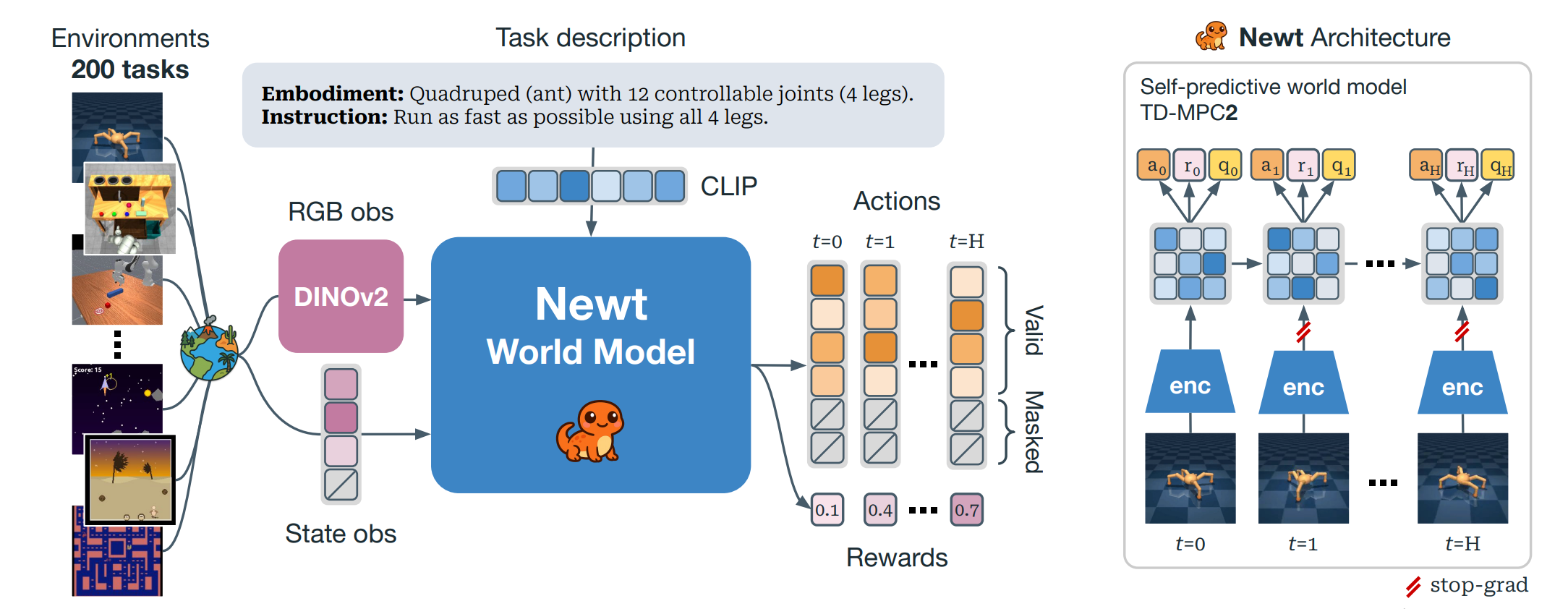
上面是文章的方法图。左边是输入,Newt同时接收很多不同任务的数据,包括RGB图像、状态信息和任务文字描述。图像先经过dinov2(上一篇文章也是用这个做编码器,看来想法是一脉相承的),文字经过CLIP编码(感觉可以对应(iii) 能够充分区分不同任务 这一点,毕竟不同任务自然语言输入不同)。
然后中间是Newt World Model。 把这些不同任务的信息放进同一个世界模型中,主要是学习[ 当前状态下做什么动作,可能会得到什么奖励 ]。因为不同任务动作维度不一样,所以无效部分会被掩码mask掉。
右边是具体的世界模型结构。基于TD-MPC2,把观测编码成隐藏状态,然后学习隐藏状态如何随动作变化,同时预测奖励和价值,用这些预测来规划动作(其实就是先学习一个能够预测未来的世界模型,再利用这个模型在内部规划动作)。
Newt 学习什么
Newt主要学习以下内容:
- Dynamics:执行动作后,下一状态会是什么;
- Reward:这个动作能获得多少奖励;
- Value/Q:长期来看这个动作好不好;
- Policy Prior:在当前状态下,什么动作比较值得尝试。
看起来Newt是在潜在空间中预测未来,为控制服务。
从专家示范到在线交互
在训练时,Newt 同时学习: 当前状态 + 动作 → 下一状态 + 奖励 + 长期价值(同时看这个动作后的长期奖励,和折扣因子对应)
然后测试时选择预计回报最高的动作执行。值得一提的是,Newt的训练流程是:
专家示范预训练 → 得到初始世界模型和动作先验 → 与环境在线交互 → 收集新经验 → 持续更新世界模型和策略 (dinowm训练开始时是先随机采样,Newt也算是先用专家进行冷启动了?正好对应了(iv) 在合理的时间范围内完成训练)
与 DINO-WM 的比较
整体看下来,Newt和dinowm一样,都选择在潜空间预测未来(看来潜空间目前是对的)。两者区别在于Newt还显式学习Reward和Value,直接套用了强化学习控制的框架,直接服务于控制。
This is the second paper in my world-model reading notes. Once again, I am recording its ideas and methods without getting into the math.
Learning Massively Multitask World Models for Continuous Control, ICLR 2026
What Newt aims to solve
The authors also believe that world models should generalize, and they introduce a benchmark containing 200 diverse tasks.
They propose their own model, Newt: first, it looks at a large collection of existing demonstration trajectories to learn roughly what the tasks involve and how to act. The same Newt model then interacts with environments across many tasks, using the new experience to keep improving.
(To me, the idea feels quite similar to DINO-WM: both aim to build a model that generalizes across tasks, and the recipe looks similar too — offline pretraining followed by online optimization. Interesting.)
Requirements for a world model
The authors argue that a reasonable world-model approach should:
- (i) Scale as the model and dataset grow — scaling laws.
- (ii) Be robust to different observation spaces, action spaces, reward functions, and task horizons. The model supports inputs such as state information and RGB images. Different reward scales are handled with discrete regression/cross-entropy and logarithmic transformations. Different tasks have different discount factors, which discount future rewards.
- (iii) Distinguish sufficiently between different tasks.
- (iv) Finish training within a reasonable amount of time.
Newt's model architecture
The figure above shows the method. On the left are the inputs: Newt receives data from many different tasks, including RGB images, state information, and textual task descriptions. Images first go through DINOv2 — the previous paper used it as an encoder too, so the ideas seem to follow a similar line. Text is encoded with CLIP. I feel this corresponds to requirement (iii), distinguishing between tasks, since different tasks have different natural-language inputs.
In the middle is the Newt World Model. Information from these different tasks goes into one shared world model, which mainly learns what reward might result from taking a particular action in the current state. Because different tasks have different action dimensions, invalid components are masked out.
On the right is the specific world-model architecture. Based on TD-MPC2, it encodes observations into hidden states, learns how those hidden states change with actions, and predicts rewards and values. These predictions are then used to plan actions. In other words, it first learns a world model that can predict the future, then uses that model to plan internally.
What Newt learns
Newt mainly learns the following:
- Dynamics: what the next state will be after an action is taken.
- Reward: how much reward the action will produce.
- Value/Q: whether the action is good in the long run.
- Policy Prior: which actions are worth trying in the current state.
It looks like Newt predicts the future in latent space to support control.
From expert demonstrations to online interaction
During training, Newt learns these together:
Current state + action → next state + reward + long-term value.
It also considers the long-term reward after the action, which ties back to the discount factor.
At test time, it chooses the action with the highest predicted return. One point worth noting is Newt's training pipeline:
Pretrain on expert demonstrations → obtain an initial world model and action prior → interact with environments online → collect new experience → continually update the world model and policy.
(DINO-WM starts with random sampling when training begins; could Newt be viewed as using experts for a warm start? That would fit requirement (iv): training within a reasonable amount of time.)
Comparing Newt with DINO-WM
Overall, Newt, like DINO-WM, chooses to predict the future in latent space. It seems latent space is the right direction for now. The difference is that Newt also explicitly learns rewards and values, directly adopting a reinforcement-learning control framework to serve control tasks.